Village Hall and Richard Philip Stanhope
History of Revesby

The present day Village Hall was gifted to the Church of St Lawrence, the Diocese of Lincoln and the people of Revesby in 1913 by The Honourable Richard Philip Stanhope.
Richard Stanhope inherited the nearby Revesby Estate in 1904 at the age of 19 upon the death of his uncle,
He served as a Lincolnshire County Councillor and Justice of the Peace, before going on to become Chairman of the Horncastle Railway Company.
In the spring of 1914, he married "Lady Beryl", daughter of the 5th Earl of Clancarty in County Galway.
Shortly after returning from honeymoon the First World War broke out. Richard was called up to serve.
Initially training with the Lincolnshire Yeomanry, he transferred to the Grenadier Guards as a captain in the 3rd Batallion during July 1915.
Richard was killed in action during the Battle of the Somme on 16th September 1916.
He was 31.

Village Hall as a Hospital
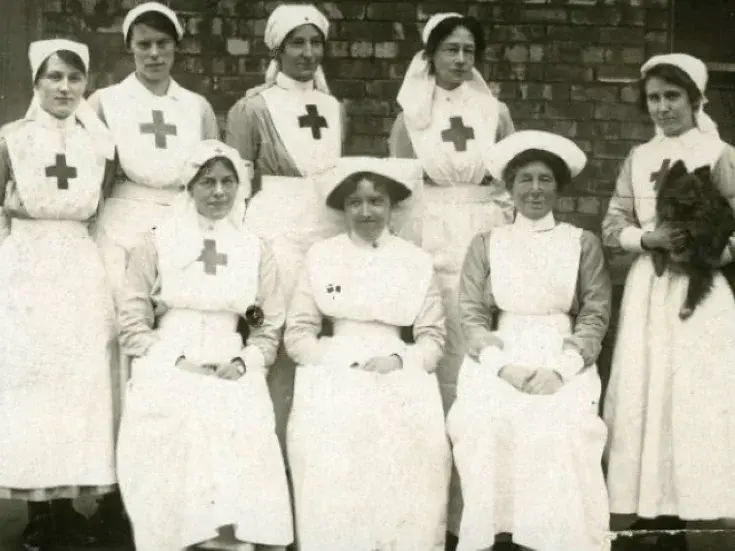
During the First World War Lady Beryl Stanhope led a committee which turned Revesby Village Hall over to the war effort, as an auxilliary hospital.
Local newspapers at the time reported the first 6 patients were admitted on the 6th November 1914.
Auxilliary hospitals played a critical role in relieving pressure on Britain’s main military hospitals, accommodating soldiers who were in recovery stages or dealing with less severe injuries.
Beds were arranged along the walls and sections of the hall were adapted to accommodate a small kitchen, washrooms and storage for medical supplies.
Volunteers, including local women, were trained as nurses and orderlies. Doctors from nearby towns visited the patients on a rotating basis. The village hall became a place for medical treatment and recuperation, where wounded soldiers could spend time away from the front lines in a quieter more familiar environment.
Locals frequently visited to bring comfort to the soldiers, donating food, reading materials and items of entertainment.
The village hall-turned-hospital also became a place where soldiers could start to heal not just physically but also mentally. Letters from soldiers who recovered in auxiliary hospitals like Revesby often mentioned the relief they felt in such peaceful surroundings.
The legacy of Revesby village hall’s wartime service became part of the village heritage, a testament to the resilience and generosity of small communities in times of crisis.
Today, it stands as a symbol of the unity and compassion shown by Revesby residents and serves as a reminder of the sacrifices made by both soldiers and civilians during one of history’s most challenging periods.
Revesby Abbey, Estate and Village Timeline
1913 - Village Hall gifted by Richard Stanhope
1904 - Revesby Estate inherited by Richard Stanhope
1885 - Estate passed to Edward Stanhope, uncle of Richard
1820 - Estate passed to James Banks Stanhope. Previous mansion house demolished and construction started on new mansion house.
1714 - Estate purchased by Sir Joseph Banks, passed to his son on his death in 1764.
1575 - Estate purchased by William Cecil of Burghley and subsequently descended to Craven Howard who built a new stately home using stone from the original Revesby Abbey.
1539 - Abbey dissolved by King Henry VIII after falling into ruin. Lands gifted to his brother-in-law Charles Brandon, the Duke of Suffolk.
1377 - Revesby Abbey recorded as having 28 monks in residence.
1199 - Lands previously granted to Revesby Abbey confirmed by KIng Richard I.
1142 - Villages of Revesby, Schithesby and Thorsby granted by the Earl of Lincoln to found a Cistercian Abbey.
1086 - Church at Revesby recorded in the Domesday Book.